Sunday, September 20, 2026

Head-To-Head: The 1969 Trinity - Unlocking the Holy Grail of Automatic Chronographs

If you have been following my horological journey, you know that my appreciation for watch collecting went into full bloom back in 2010. From my career perspective as a statistician since 1990, an actuarial analyst since 1992, a financial analyst since 1994, and a financial engineer since 2008, I bring an analytical eye to technical specifications, movement architecture, value-for-money, and historical design ethos.

In the entire history of horology, no single year holds more legendary status for chronograph enthusiasts than 1969. It was the watershed year when three independent, competing horological factions simultaneously unlocked what was long considered the Holy Grail of mechanical watchmaking: the automatic chronograph movement.

Those three historic factions were:

  1. Zenith, which unveiled the high-beat El Primero.
  2. Seiko, which introduced the Caliber 6139—the world’s first automatic chronograph featuring both a column wheel and a vertical clutch.
  3. The Project 99 Consortium (Heuer, Breitling, Buren-Hamilton, and Dubois Depraz), which developed the micro-rotor Caliber 11 "Chrono-Matic".

To mark the 50th anniversary of that momentous 1969 race, members of all three historic groups released special commemorative timepieces. After acquiring the tribute models from Seiko and Hamilton, I was finally able to complete my personal "1969 Trinity" with the addition of the Zenith Revival.

Today, we are putting these three 50th-anniversary milestone chronographs from my collection head-to-head: the Zenith Chronomaster Revival El Primero A384 (Ref. 03.A384.400/21.C815), the Seiko Prospex Automatic Chronograph 50th Anniversary "Panda" Limited Edition (Ref. SRQ029J1 / SBEC005), and the Hamilton American Classic Chrono-Matic 50 Auto Chrono Limited Edition (Ref. H51616731).

Sunday, September 13, 2026

Deep Dive: Tanks of the East - Tracing the ISO-Tested Evolution of Orient’s Legendary M-Force Collection

Established on July 13, 1950, Orient is currently operating as a subsidiary of the Seiko Epson Corporation and occupies a unique space in Japanese watchmaking. Unlike other manufacturers that lean heavily on external outsourcing, Orient remains fiercely independent, designing and manufacturing all of its robust movements entirely in-house.
 
At the absolute peak of Orient's tool-watch catalog sits an iconic, over-engineered lineage: the M-Force series. First launched in 1997, the "M" in M-Force stands for three definitive principles: Mechanical (running solely on kinetic energy, without batteries or solar), Massive (solid, shock-resistant architecture), and Maverick (daring, original, and visually distinct design language). In 2020, Orient introduced a fourth "M"—Magnificent—to capture the raw, volcanic power of the Earth through a revived design catalog.
To fully appreciate this "Mechanical Force," we must dive into the history of the collection. Today, I am taking an analytical look at the timeline of the M-Force series, using the four distinct models in my personal collection—the stainless steel WV0021, the left-handed WV0091E "Beast," the pioneering titanium DV01002B, and the geometric SEL07002B0 "Delta"—to trace how Orient has evolved this legendary line over the decades.
 

Sunday, September 6, 2026

Brand Cluster: Supersonic Travel and Tactical Trenches - A Dual-Headed Showdown of Glycine's Ultimate Tool Watches

If you have been following my horological journey, you know that my appreciation for watch collecting went into full bloom years ago. From my career perspective as a statistician and financial analyst—with a professional background in actuarial work and financial engineering—I bring an analytical eye to technical specifications, value-for-money, and historical design ethos.
 
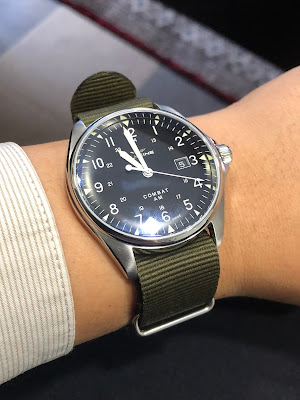
When it comes to historic Swiss tool watches that offer immense heritage without demanding astronomical premiums, Glycine is a brand that occupies a special place in my collection. Founded in 1914 by the ingenious Eugène Meylan in Bienne, Switzerland, Glycine has a celebrated history of manufacturing robust, purpose-built military and aviation watches. Today, we are putting two distinct, vintage-inspired Swiss automatic models from my collection head-to-head: the Combat 6 Vintage (Reference GL0122) (below left) and the Airman SST 43 GMT (Reference GL0311) (below right).


CONTRIBUTE FOR THE UPKEEP OF THIS BLOG

Any contributions is appreciated!